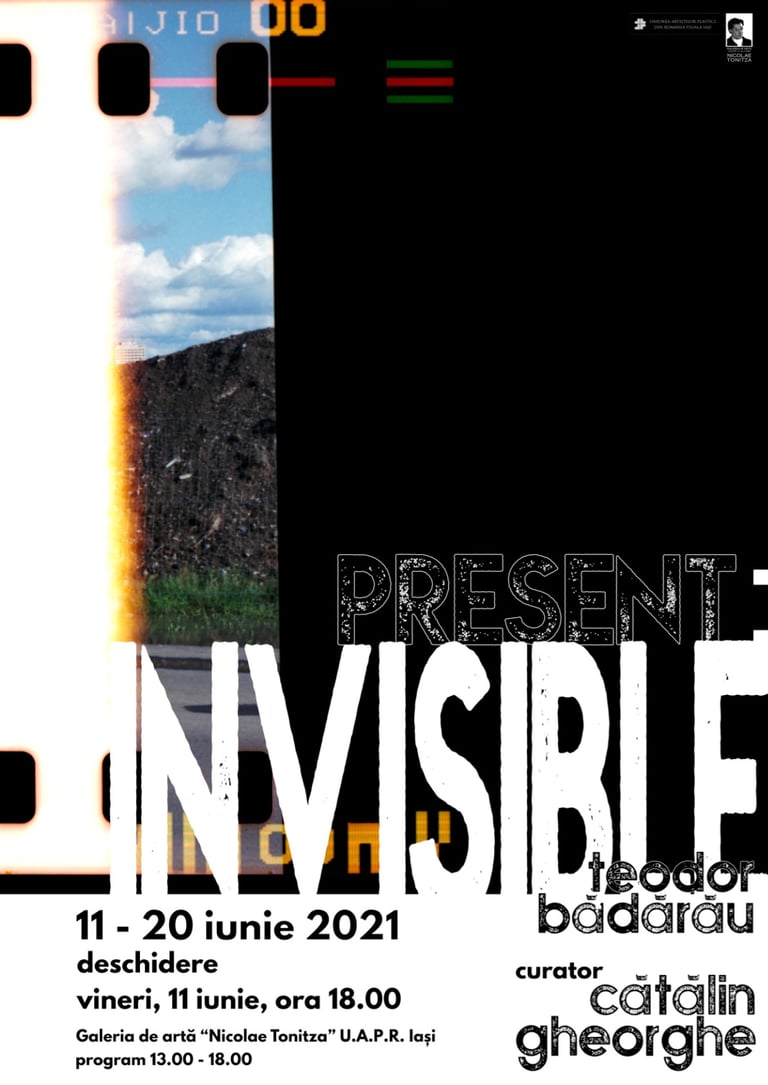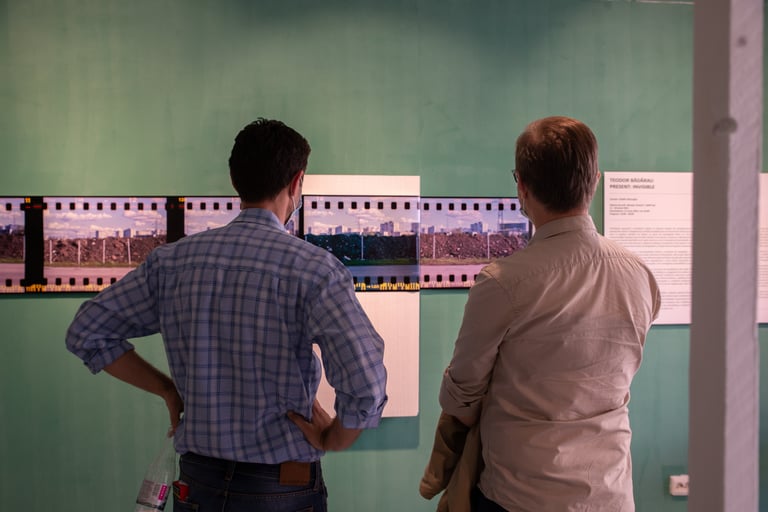
Present: invisible
The seemingly shifting conditions of urban coexistence reflect a mode of (self)‑structuring a landscape that is, to a certain extent, mental. Photography enables a form of de‑documentation of one’s experience of moving through space—an experience that becomes a point of convergence between the transversal logic of an artistic inquiry and the operative effects of post‑photography. Through a sequence that inherently assembles scenic frames and meta‑frames of representation, and through immersive acts followed by moments of detached reflection, the present acquires an aura of invisibility that short‑circuits both the meaning of photographing and the rhetorical consequences of exhibiting its results.
In his research practice—refunctionalizing the technical apparatus of the camera, recontextualizing the traversed environment (through a social reflection that extends into fiction, grounded equally in the inflections of everyday life and in the experimental, conceptual use of the camera), and exploring exhibitionary modes of assembling elements of this research—Teodor Bădărău transforms invisibility, understood as a public secret, into an urgency of making‑present and making‑public.
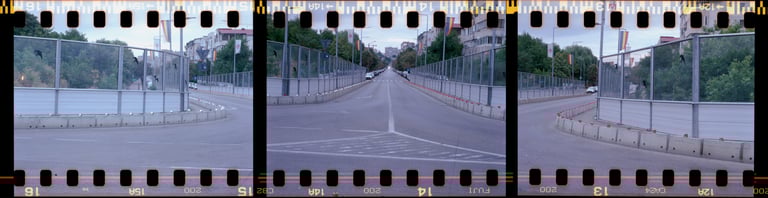
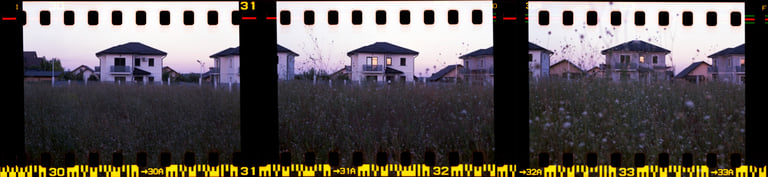
At the level of his observational metadiscourse, structured around identifying the repetitive duality of photographic images and the conditions of dwelling, Teodor Bădărău undertakes a critical dismantling of the false narrative that social comfort is improved by moving from collective urban housing to peri‑urban single‑family homes. As the artist notes, the “dormitory neighborhoods” built vertically in the urban context are simply transposed into “residential neighborhoods” spread horizontally across metropolitan zones, while preserving the same conglomerate patterns of habitation—continuously subjected to financial exploitation.
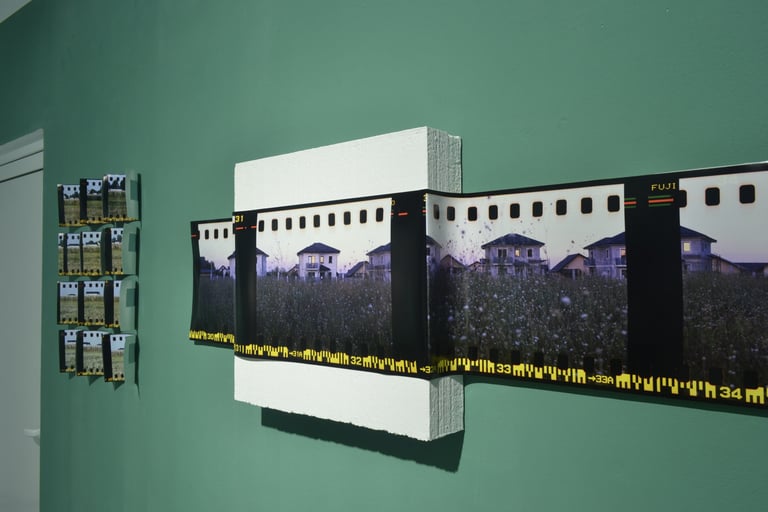
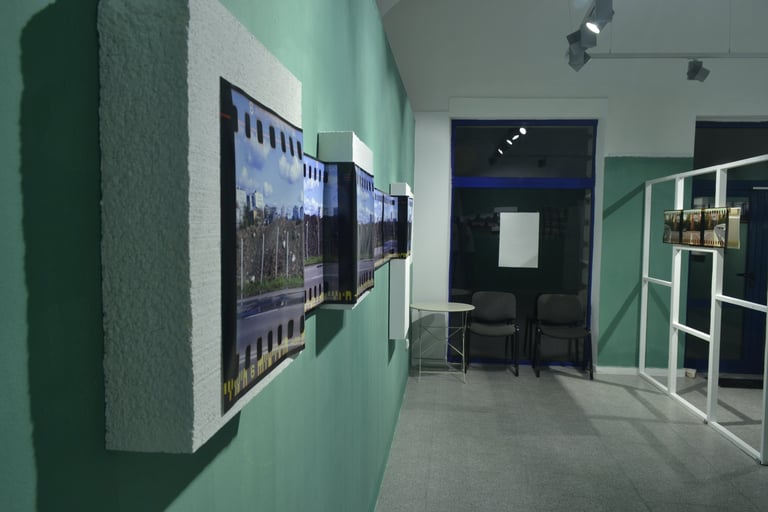
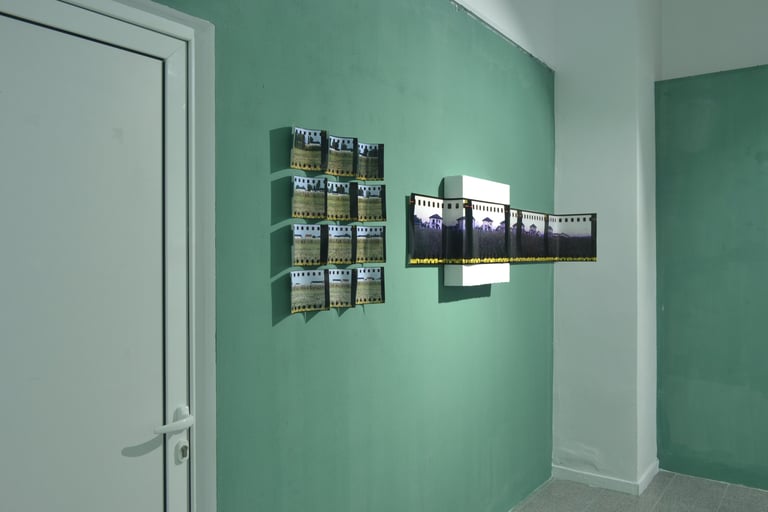
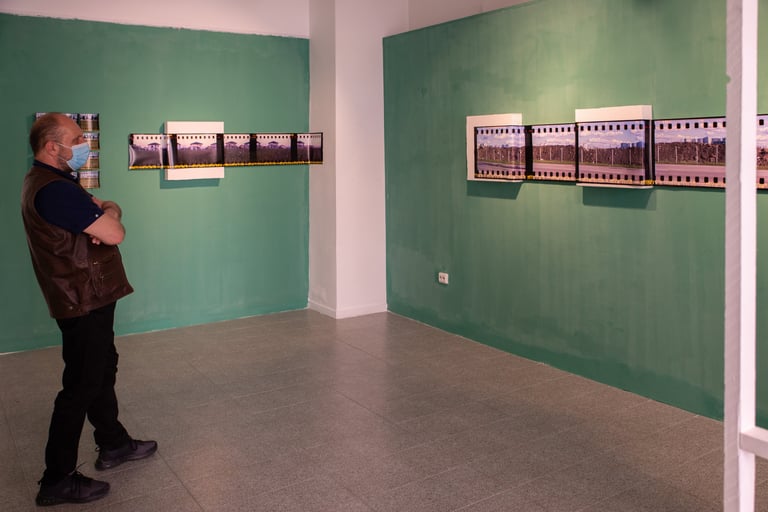
At the level of his professional metadiscourse, Teodor Bădărău uses the camera not only as a tool for analyzing the exhibition’s mix of subjects (reflections on construction, dwelling, and urban mobility; on the photographer’s movement through the photographed landscape; on the deconstruction of temporality through the sequencing of spatiality; on the functions of reading the landscape through the installation of photographic assemblages, etc.), but also as a symbolic index for re‑signifying image‑making in the context of accelerated technological transformations.
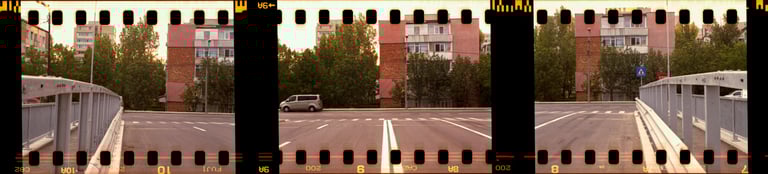
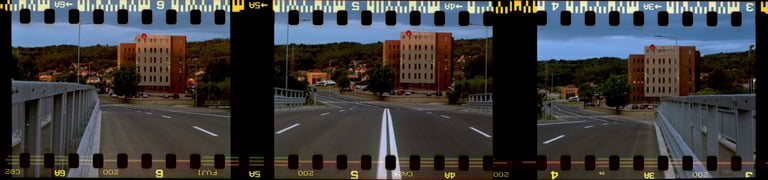
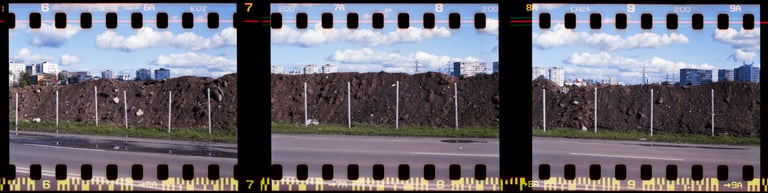
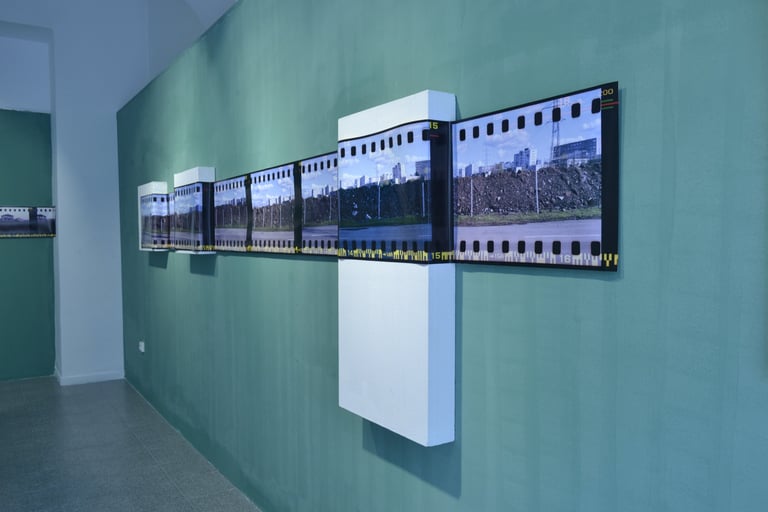
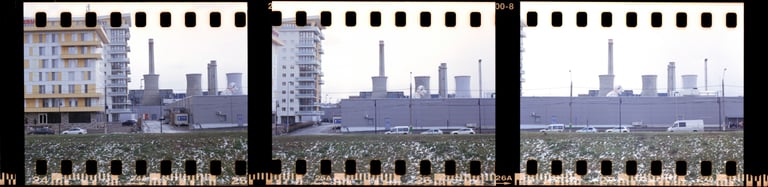
Teodor Bădărău subverts the programmed functionality of the camera by loading 35mm film into a cassette designed for 120mm film, producing an atypical photographic frame without altering the camera’s structure. In his artistic research, both through exploiting the camera’s capacity to alter perception and through a shooting method that destabilizes linear perspective, he intervenes technically and reflectively upon the photographic space—incorporating the perforated edges and technical inscriptions of the 35mm film as witnesses to an expanded perception, in an attempt to index the real, circular space of the image.
The perforations along the edges of the scanned negatives are symbolically activated as “holes in the reality of the image.” From the viewer’s perspective, one may either enter the depth of the assemblage’s invisible meaning or remain cautiously at the surface, accepting the reality represented by the photographic medium.
Teodor Bădărău is equally invested in reconsidering the conceptual historicization of photography and photographic technology (from the camera obscura and daguerreotype to the digital revolution and the objectification of the photograph), as well as in critiquing aesthetic hierarchies by aligning his practice with amateur photographic methods (cheap film, outsourced development, embracing errors such as scratches, color shifts, or chemical imperfections) in contrast to professional obsessions with technical control and image quality—obsessions that often lead to sentimental or commercial fetishization of the photograph‑as‑object. For Teodor Bădărău, the image is a vehicle for mediating ideas, not an end in itself. Entering the exhibition may feel like entering the spirit of a landscape—both familiar and uncanny—but it is less an invitation into the artist’s mind and more an entry into a digital‑cinematic camera obscura where what is invisible is nothing but present.
Cătălin GHEORGHE, Iași, 2021